Today we’ll talk about fear. And there’s quite a lot of ground to cover. Don’t be afraid though (pun intended), it’s gonna be fun.
Maybe for some this is common knowledge, for many others it may come as a surprise, but the most common phrase in the entire Bible is ‘do not fear’, or different variations of it that hold and convey the same meaning.
It is said to appear throughout the sacred text 365 times, so it made quite a buzz not only because it’s the most repeated message in the scriptures, but because of the specific number of times it is said to be repeated, equivalent to the number of days in a year (If you’re skeptical about the number, as you should be, I politely invite you to count yourself. If I’m wrong you’ll get to publicly shame me 🔔, If I’m right nothing happens, but in either case you’ll end up reading the Bible so that’s a win either way).
The same message resonates in other sacred texts around the world, including but not limited to the Bhagavad Gita, the Tao Te Ching or the Quran.
To some extent, we can argue that fear is good. It keeps us from falling from great heights, getting burnt, eaten by lions or bitten by snakes. All good things. But, fear can also work against us. It can keep us from achieving our potential. It can cripple and paralyse our minds and senses in situations that demand clear thinking and purposeful action.
Today, there aren’t many lions around to eat us, snakes to bite us, or fires to burn us, so most of our fears have turned social. Don’t get me wrong, I think everyone will fear a lion when they come face to face with one, it’s just that this situation has become less and less common during our times. Sure, you can have arachnophobia (fear of spiders), or ophidiophobia (fear of snakes), but let’s be honest, how often did you get bit by a spider or actually seen a snake in real life?
Nowadays we don’t fear physical creatures coming to get us as much as situations. We are afraid of our friends laughing at us because we had something between our teeth at lunch, our social image taking a hit because a girl who we like didn’t want to go out with us, being rejected by our peers because we think Trump is a compulsive liar and hustler and has no place in the leadership of any country, nevertheless one of the largest superpowers in the world, etc.
We are afraid of dancing because “we don’t know how to dance”, afraid of singing because “we don’t have a voice”, afraid of writing because “we are not writers”. What we seem to have forgotten is that it’s not titles and accolades that make singers singers and dancers dancers. It’s the very act of singing or dancing themselves.
I think we lost our ability to do something without seeking praise, recognition, or to instantly be good at that thing. To look stupid for long enough to allow ourselves to get good at something, or to simply do something for fun, with no ulterior motive other than the action itself. Our benchmarks in everything are the ones who excelled in specific fields, disregarding the years of effort they put into reaching their current levels of mastery, and somehow not taking into account all the years they spent sucking at whatever they do, before they got good at it.
It’s not our lack of potential or our capabilities that hold us back, but our fears. Of failure, of rejection, of public shaming, etc. That’s why everyone’s a much better dancer after a few glasses of liquid spirit. And that’s why everyone’s a better player (at everything) when no one’s keeping score as opposed to when there’s something at stake. While alcohol turns down the “what will the others think if I do/say this” control in our mind and blasts up the “I don’t give a f*ck” one, playing something just for fun, no score, no stakes, removes any pressure and allows us to move freely. Even if just for a few minutes, or hours. That’s usually how much it takes to get back to our “real selves”. But what if our real selves are the ones that come out during those rare and fleeting “I don’t give a f*ck” moments?
How many of us can truly say that they live lives free of social fears? How many can truly say that they would behave the same regardless of who’s sitting at their table, be they president or beggar? My guess is that very few. Most of the time I think we tailor our behaviour according to the person sitting across from us. We always have an endgame, always wondering how we can use the people around us to better serve our goals. So we put up a mask that we think they’ll like and can get us closer to what we want. We turn into chameleons because we lack the courage to be ourselves. The courage to be disliked. And after a life of people-pleasing, of crafting and wearing a different mask for every person or circle we interact with, we may find coming back to our authentic selves as something very hard. Because we may not know who that is. And what if people won’t like our authentic selves? The answer is simple: If they don’t like it – f*ck ‘em. It’s probably better to be disliked for who you are, than to be disliked for who you are not.
The best things in life sit on the other side of our fears. And we just need to shift our perspective a little, and start looking at fear not as a ⛔no-entry sign, but more like a sign post of where our mission lies. Not as something that always reminds us of our lack of courage, but as a prerequisite for it. Courage is not the absence of fear, it’s acting in spite of it, so it’s a two step process that first requires you to be afraid. And with pushing past that feeling we usually get a sense of achievement and liberation as great as the fear that was once holding us back. Along with the realization that the thing that once held so much power over us, and kept us from doing so many things, was mostly just a figment of our imagination, just like the Boogyman.
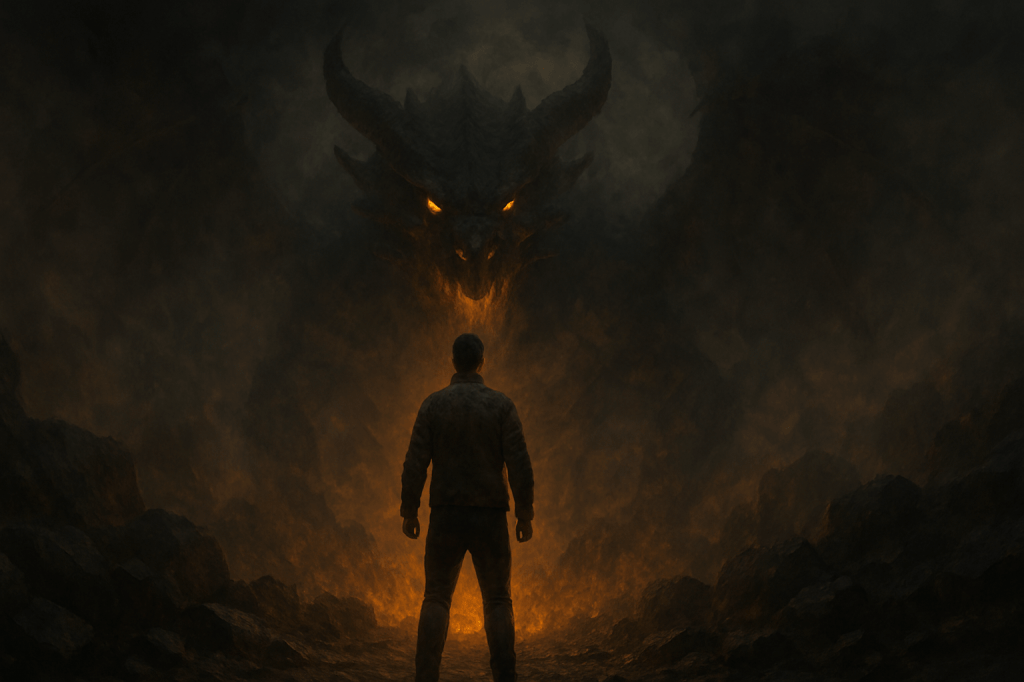
As Seneca once said, “we suffer more in imagination than in reality”. Romanians also have a saying that goes something like “The devil is not as black as we imagine it to be”, which refers to pretty much the same thing. A great analogy to drive home the idea would be our fear of the dark, which ultimately stems from uncertainty, from not being able to see what’s out there. While darkness rules over the room, everything exists in the realm of imagination, from the Boogyman to the monsters hiding under the bed or in the closet. Once we turn the lights on and reality kicks in, all those figments of our imagination collapse.
As someone who struggled a lot with social anxiety over the years I can say that caring too much about what other people think is a sure recipe for being miserable all the time. People will judge you for keeping to yourself, just as much as they will judge you for being too outspoken. They’ll judge you for being too lethargic, for having too much energy, for not having dreams, for being too ambitious, for never taking any risks, for always living on the edge, being too much, not enough or “too mid”. And you probably see where this is going – people will judge you regardless of what you say or do. Caring too much about their judgement will only push you closer to the brink, trapping you in a never ending quest of pleasing others that will at no point lead to your fulfillment. The only thing that leads to your fulfillment is when you realize the foolishness of the quest and decide to stop playing. Then the world opens up and you’re truly free to say, do and be whatever or whoever YOU WANT.
Now, this is starting to become pretty bulky, and if your attention span is as good as mine, chances are I lost you already. So, I’ll just close up by sharing this: the widespread misconception today is that the opposite of fear is courage, when in fact courage is merely acting in spite of fear. The truth is, there’s only one thing powerful enough to shake your fears off and blast the very foundations they are standing upon – and that is not courage, it’s faith. And here, there’s a fork in the story, depending on your spiritual orientation.
For spiritual people:
- The faith that there is a higher intelligence out there inherent to all creation (I call it God, but you’re free to call it whatever you’re comfortable with (Allah, divinity, the universe, cosmic consciousness, the soul of the world, or whatever names He went and goes by nowadays)
- The faith that this higher intelligence doesn’t always (or ever) work in ways you can make sense of, but it most certainly always works in your best interest
- The faith that the more you give up on the need to control everything and leave room for uncertainty, the more room you make for Him to work in your life
For secular people – instead of faith perhaps you can lean on these core beliefs, I’m sure that’s a term you’ll be more comfortable with:
- Growth implies discomfort and pushing past one’s fears.
- Anyone can learn and get better at anything if they get comfortable with looking stupid for a while
- You learn more from failing than by succeeding
- Suffering and rejection are inescapable parts of life
- People will judge you regardless of what you say/do
- The “what ifs” will surely hurt more than any broken bone or bruised ego
Great. Now, to conclude: Faith does not mean to go jump off a cliff literally hoping that He’ll catch you, it means go jump off a metaphorical one and have conviction that not only you’ll stick the landing, but at the bottom of the cliff you’ll find much more than what your heart ever dared to dream. Most of the time we don’t have a clear vision of the road ahead, and we can’t see further than the first step. The difference between finding fulfillment and wondering “what if” for the rest of our lives is made by a single leap of faith, in a situation when there was no clarity, certainty, no guarantees, and no safety nets.
 Let me overthink it
Leave a comment